0
Training retention
Customer corpora are not pooled for model training
Zero retention. Local and cloud. Phone, desktop, and browser. Five-plus turbo engines. Verification loops. Evidence reporting. Global vetted sector knowledge bases. Vevesh indexes the folders you already trust — then answers with citations your lead can sign.
You asked
What are the fatigue load combination requirements for an IEC Class IIA site with 50-year design life?
Vevesh answer
GroundedFor Class IIA, your indexed IEC 61400-1 section 7.4.2 requires DLC 1.2 and 6.4 combinations with the site-specific turbulence class applied. Your foundation report (Rev C) already flags the governing combination as My at tower base under DLC 6.1...
0
Retention training
Zero retention on customer corpora
5+
Turbo engines
Express → Premium extraction
100%
Citation grounded
Evidence-ready answers
3
Surfaces
Phone · desktop · browser
Super private · zero retention · military-grade boundaries
Privacy manifesto
Consumer AI treats your uploads as fuel. Vevesh treats them as classified engineering material — isolated planes, explicit boundaries, and architecture that assumes your worst-case leak is unacceptable.
0
Training retention
Customer corpora are not pooled for model training
3
Isolated CF accounts
Marketing · ops workers · user KB data — separated
∞
Local-first option
Index on your machine; cloud only when you choose
RBAC
Team privileges
Customizable access per project and knowledge base
The problem
Decades of specs, reports, and calculations sit in directories your team trusts. Then someone asks you to drag those files into a chat window — again — and trust a summary with no page number.
The Vevesh answer
Index where the work already lives.
Persistent folder indexes. Four extraction engines. Citations your lead engineer can verify before sign-off. Team knowledge bases when the corpus belongs to everyone — not just the laptop that indexed it first.
See how we comparePlatform capabilities
Privacy, turbo engines, verification loops, team RBAC — not a slide deck. Explore the full stack on the features page.
Privacy & trust
Vevesh is architected so customer corpora stay in isolated data planes — not pooled into shared model fine-tuning. Query traffic is processed for the answer, not harvested for product analytics.
All privacy features →Core
Zero retention by design
Enterprise
Military-grade privacy posture
Hybrid
Local AND cloud — you choose
Multi-surface
Phone · computer · browser
Zero retention by design
Your prompts and source files are not a training dataset.
Military-grade privacy posture
Boundary-first engineering for teams who cannot leak load cases.
Respect for norms & standards
IEC, ISO, Eurocode — cited by clause, not paraphrased from memory.
State-of-the-art verification loop
Retrieve → reason → cite → verify. Not one-shot guessing.
Project management workflow
Indexes follow how projects actually move — not how SaaS wishes they did.
Version control & revision awareness
Content hashing means only what changed gets re-processed.
Extraction
Local or server extraction per knowledge base — from lightning-fast text pulls to premium vision for the messiest scans.
Plain text layer extraction. Ideal for digital PDFs, Word docs, and clean reports where speed matters.
Best for: Daily specs, code, markdown
Preserves headings, tables, and document hierarchy. Cloudflare toMarkdown for complex Office and PDF layouts.
Best for: Technical reports, tables
Workers AI vision for scanned images and messy documents. Falls back intelligently on unsupported formats.
Best for: Scanned drawings, photos
Higher-quality vision model for the toughest scans — handwritten margins, low-contrast plots, legacy archives.
Best for: Legacy archives, field notes
Local or server — your call
Extract on your machine for full control, or push raw files to the edge pipeline when you want server-side processing.
Use cases
Design partners use Vevesh wherever project knowledge is folder-shaped, revision-heavy, and too valuable to re-upload every Monday.
Wind & renewable energy
Index IEC extracts, foundation reports, and site assessments together. Ask load-combination questions with clause-level citations — not paraphrased guesses.
Civil & structural
Rev A through Rev E live in one folder tree. Vevesh hashes incrementally so only changed documents re-index — critical when submissions land weekly.
Software & R&D
Mix README files, API specs, and architecture PDFs. Hybrid retrieval finds the implementation detail and the design rationale in one grounded answer.
How it works
The workflow mirrors how you already organize work — Vevesh adds the AI layer without forcing a new filing system.
Choose any project directory — specs, reports, CAD exports, code. No forced “import everything to our cloud” step.
Vevesh scans, hashes, and extracts with the engine you select. Local on your machine, or server-side via the edge pipeline.
Chat with full project awareness — citations, cross-document reasoning, and optional shared knowledge bases for the team.
Platform
Hybrid stack: local indexing on your machine, managed retrieval where it helps, edge workers for scale-sensitive paths. This marketing site lives on its own Cloudflare account — separate from customer data.
Your machine
Desktop app · local index
Edge
CF Workers
Server
Self-host / Dell
Team KB storage
R2 · Vectorize · D1 shards
Consumer AI
General AI · ephemeral file upload
Pros
Cons
Enterprise suite
M365-embedded assistant
Pros
Cons
Knowledge wiki
Wiki-first Q&A inside Notion
Pros
Cons
Enterprise search
Enterprise workplace search
Pros
Cons
Engineering AI
Folder-native engineering RAG
Pros
Cons
Design partners
"We stopped re-uploading the same IEC PDF every sprint. The folder index just stays current — that alone saved hours."
"Citation paths my reviewers can click beat any summary Copilot gave us on SharePoint-only content."
"Ghost mode for our internal standards KB was the policy knob our legal team actually understood."
Trust & security
Vevesh is designed for engineers who cannot afford hallucinated load cases or mystery data residency. We optimize for traceability, isolation, and control — not engagement metrics.
Private preview
Design partner program
Self-host
Optional on-prem path
EU-ready
Configurable deployment
Source folders remain on your machine or infrastructure. Index metadata and team KB settings live in Postgres — never scattered across anonymous SaaS uploads.
Customer knowledge bases run on dedicated Cloudflare accounts with separate workers, R2, and Vectorize — not co-mingled with marketing or admin traffic.
Every grounded answer links back to indexed files and pages. Ghost mode hides KB existence from probing; open mode makes citations first-class.
Team knowledge bases use Stripe subscriptions. Server extraction and embed usage are metered per engine — no surprise token black boxes.
Hybrid vector + BM25 retrieval, multi-provider AI routing, desktop-native filesystem access, and optional self-hosted server deployment.
Vevesh is in private preview with design partners in wind, civil, and software engineering. We ship against real folder workflows, not demo PDFs.
Integrations & stack
Desktop app
Native folder access
Cloudflare Workers
Edge extract & index
Vectorize + R2
Team KB storage
Postgres
Settings & billing
Stripe
Team subscriptions
Multi-provider AI
Routed via gateway
Blog
Architecture notes, standards traceability, and pipeline decisions from the team building folder-native RAG.
A deep technical guide to zero-retention design, military-grade data boundaries, and why engineering teams cannot treat AI like consumer chat — from the architects of Vevesh.
Read article
Promote a folder into a billed, shared knowledge base with ghost or open citation modes. How Vevesh handles membership, Stripe billing, and retrieval policy.
Read article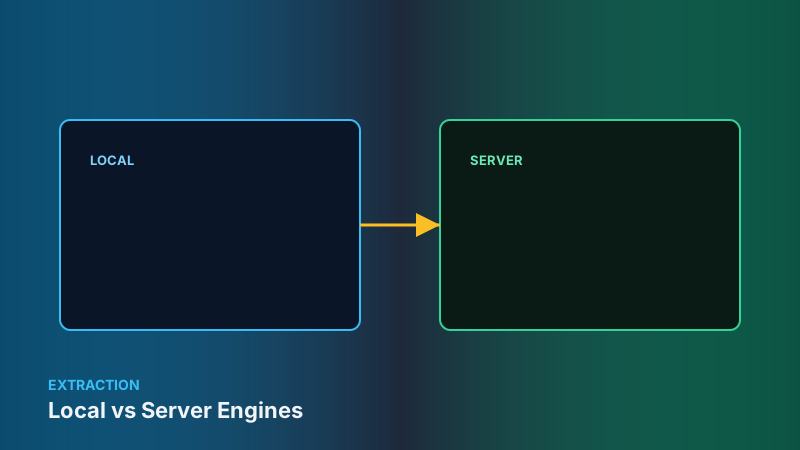
Express, Structure, Flow, or Premium? Local desktop extraction vs server pipeline— a practical guide for engineering document sets.
Read articleFAQ
No. Your source folder stays where it is. Vevesh scans and indexes content locally by default. Team knowledge bases sync extracted chunks and metadata to managed storage — raw files only when you explicitly choose server extraction mode.
Upload tools treat files as one-off attachments. Vevesh maintains a persistent, searchable index tied to your folder structure — with hybrid retrieval, engineering RAG routing, and page-level citations on every grounded answer.
Yes. Vevesh supports a self-hosted server path for teams that need on-prem control. Managed cloud components (edge workers, team KB storage) are optional layers — not mandatory for every workflow.
PDFs, Office documents (Word, Excel, PowerPoint), plain text, code, and common engineering exports. Extraction depth depends on the engine you select — from fast text-layer pulls to premium vision for scanned archives.
An owner promotes a folder into a hosted, billed corpus. Members see it as a sector in chat. Owners control disclosure mode (ghost vs open citations), extraction settings, and Stripe-backed subscription billing.
Vevesh is in active private preview with design partners. Core indexing, chat, and team KB flows are live; we are hardening server extraction pipelines and onboarding teams incrementally.
Vevesh is in active development with early design partners. Reach out to join the preview or discuss deployment for your team.
No spam. No sales deck unless you ask. We onboard engineering teams who have real folders to index.