
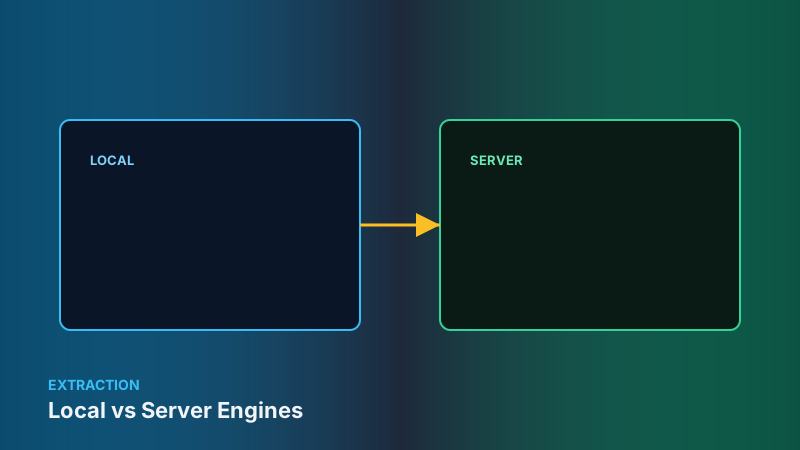
Local vs server extraction — choosing the right engine for your knowledge base
Express, Structure, Flow, or Premium? Local desktop extraction vs server pipeline— a practical guide for engineering document sets.
Not every PDF deserves a vision model. Not every Word doc needs OCR. Vevesh gives engineering teams four extraction engines and a choice between local and server processing—because document quality in the wild is messy, and one-size-fits-all parsing wastes time and money.
The four engines at a glance
| Engine | Best for | Trade-off |
|---|---|---|
| Express | Digital PDFs, plain text, code | Fastest; skips layout fidelity |
| Structure | Reports with tables & headings | Slower; preserves document hierarchy |
| Flow | Scanned images, mixed layouts | Vision-backed; higher compute |
| Premium | Legacy scans, low-contrast plots | Highest fidelity; highest cost |
You set this per knowledge base, not globally—so your daily code repo can run Express while your archive of scanned field notes runs Premium.
Local extraction: control on your machine
Local mode means the desktop app extracts and chunks on your hardware, then uploads artifacts through the sync pipeline. Your source folder is never the write target—Vevesh reads, it does not reorganize your tree.
Choose local when:
- IT policy restricts raw file egress
- You want predictable offline-first workflows
- Document sets are moderate size and you have desktop compute
Server extraction: scale without touching the folder
Server mode uploads raw files to the managed edge pipeline. Remote workers extract, chunk, embed, and index—while your folder stays authoritative on disk.
Choose server when:
- Laptops should not run heavy vision passes
- You want uniform processing for a shared team KB
- Batch sizes are large and you prefer managed compute billing
Atomic sync rules matter
Partial indexes are worse than no index. Vevesh syncs in complete-file batches—chunks for a file land together, never half-indexed states that pollute retrieval.
Watch the pipeline dashboard: raw sent → chunks complete → indexed → in database. Four metrics, one honest story.
Decision checklist
- Digital-first corpus? Start Express locally.
- Tables and annexes dominate? Structure.
- Scans and photos? Flow or Premium on server.
- Mixed team + billing? Server KB with per-engine metering.
Try before you standardize
Run a pilot folder with two engines side by side. Compare citation quality on the same ten questions. The right engine reveals itself quickly—usually in the first afternoon, not the first quarter.